1. Analytical Force Model
Derived an empirical inter-particle force model for paramagnetic grains subjected to uniform external magnetic fields, resolving dipole-dipole interactions and orientation-dependent cohesion.
Developing the first experimentally validated Discrete Element Method (DEM) framework in LIGGGHTS to simulate paramagnetic granular regolith under uniform magnetic fields on M-type asteroids like (16) Psyche.
Geophysical Context & Motivation
Asteroid (16) Psyche is the largest M-type (metallic) asteroid in our solar system, targeted by NASA's Psyche mission. Unlike silicate asteroids like Bennu or Ryugu, M-type bodies contain high concentrations of metal and paramagnetic iron-nickel grains.
In low-gravity environments, inter-particle cohesive forces govern surface morphology, crater degradation, and mass-wasting events. When an intrinsic or remnant magnetic field is present, paramagnetic inter-particle forces introduce directional cohesion that alters avalanche slope angles and granular fluidity.
This dissertation research developed the mathematical formulation, experimental validation, and open-source simulation tools required to model magnetic cohesion in space science.
Key Research Contributions
Derived an empirical inter-particle force model for paramagnetic grains subjected to uniform external magnetic fields, resolving dipole-dipole interactions and orientation-dependent cohesion.
Developed and published LIGGGHTS-Public-Mag v1.0.0 on GitHub — the first open-source DEM code enabling magnetic cohesion integration for planetary scientists.
Formulated explicit mathematical criteria for integration time-step bounds to ensure numerical stability under steep magnetic force gradients in high-particle DEM runs.
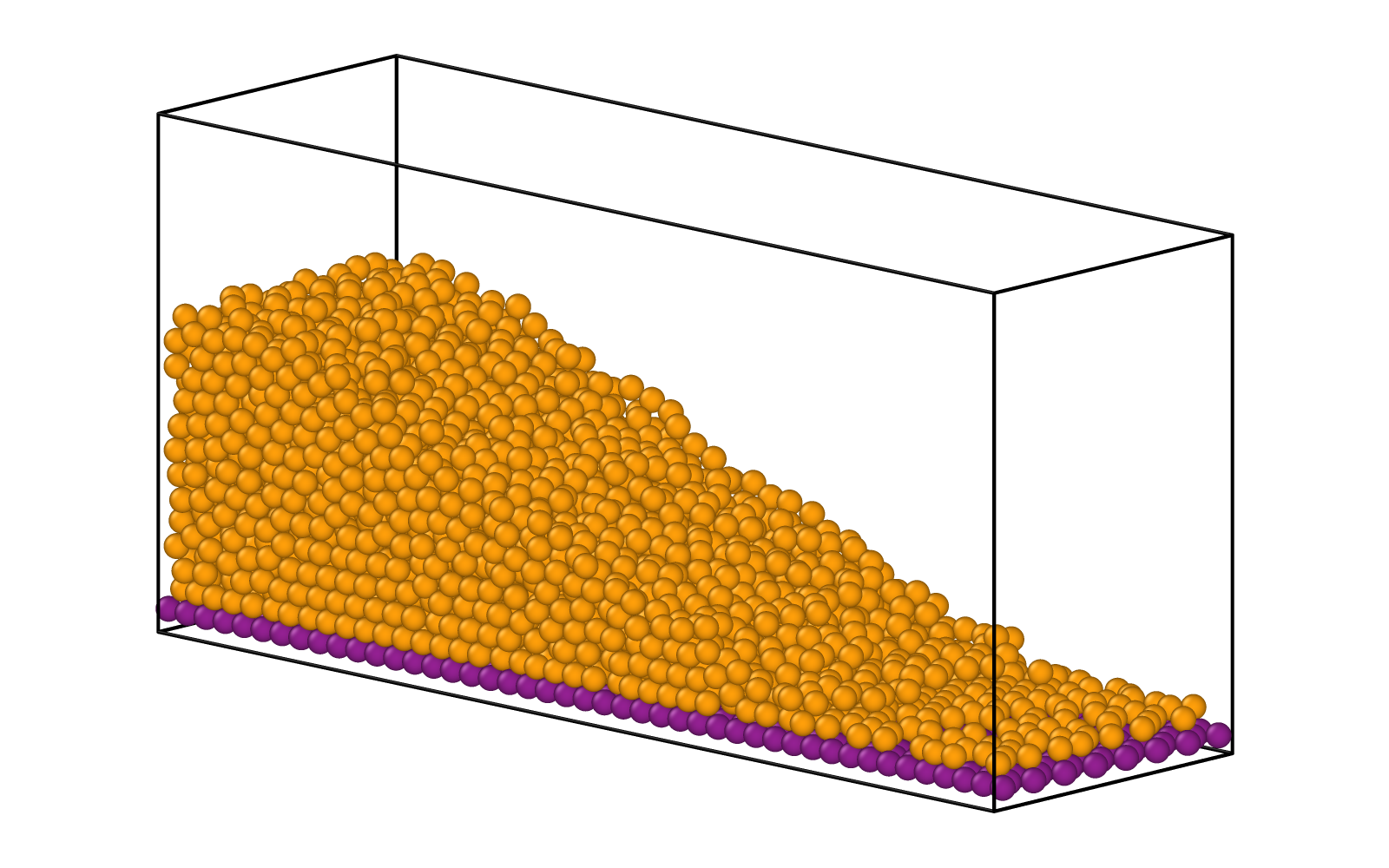
Conducted multi-scenario avalanching simulations to map surface morphology conditions on metallic asteroid 16-Psyche under remnant magnetic fields.
Proposed a bulk magnetic bond number (Bmag, bulk) framework defining flow regime transitions: cohesion onset at Bmag, bulk ≈ 5, correlated avalanching at Bmag, bulk ≳ 14, and plastic flow at Bmag, bulk ≳ 25.
Accounting for multi-body field amplification (S ≈ 49.14) and Psyche's microgravity (g ≈ 0.13 m s-2), ambient remanent fields of 30 µT cohesively bind metallic grains up to a ≈ 0.31 mm, whereas weak 0.3 µT fields govern nanoscale regolith dynamics (a ≈ 31 nm).
Associated Scholarship
Sikka, A. & Hartzell, C. M. · Accepted to The Planetary Science Journal (PSJ).
Sikka, A. & Hartzell, C. · Granular Matter, Vol. 28, No. 3, pp. 53.
DOI: 10.1007/s10035-026-01643-x ↗Sikka, A., DesJardin, I., Leps, T., & Hartzell, C. · The Planetary Science Journal, Vol. 4, No. 7, pp. 129.
DOI: 10.3847/PSJ/ace323 ↗The custom LIGGGHTS C++ source code, force fix modules, and sample simulation scripts are publicly available on GitHub under an open-source license.